0%

Choosing the best Outdoor Teak Sofa Set involves more than comparing photos and prices. Outdoor furniture must handle sunlight, rain, humidity, and daily use. Teak is valued for its natural oils, dense grain, and resistance to outdoor conditions. However, not every teak sofa offers the same quality.

A practical evaluation begins with the wood itself. Look for responsibly sourced solid teak, consistent grain, and carefully sanded surfaces. Check the frame joints closely. Strong mortise-and-tenon connections usually provide better stability than loosely fitted hardware. Sit on the sofa before buying, if possible. Notice whether it feels balanced, firm, and comfortable.

Cushions deserve equal attention. Outdoor-grade fabric should resist fading and dry reasonably quickly after light rain. Removable covers make cleaning easier. Dense foam can improve support, but it may retain moisture if ventilation is poor. Small details matter here.

Measure the patio carefully. A large sofa can overwhelm a narrow balcony. Leave enough space for walking, tables, and opening nearby doors. Consider the sofa’s natural teak color, too. It may gradually become silver-gray without regular oiling. That change is normal, not necessarily damage.

Reliable sellers should provide clear dimensions, material details, care instructions, and warranty terms. Independent reviews can reveal problems that product photos hide. No checklist is flawless. A stylish set may still have uncomfortable cushions or weak support. The right choice balances craftsmanship, comfort, maintenance, weather exposure, and long-term value.
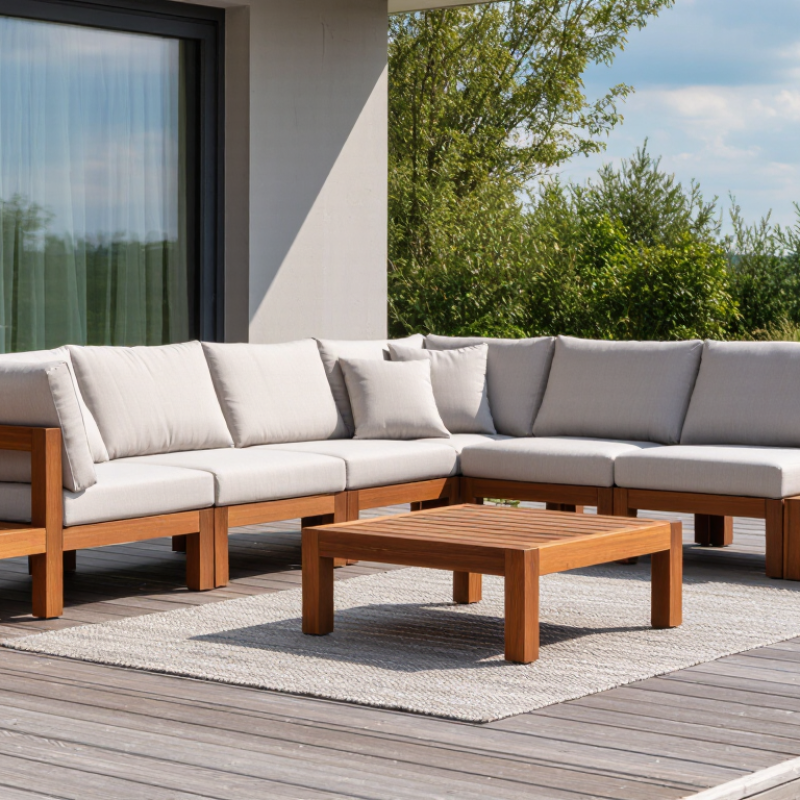
How to Choose the Best Outdoor Teak Sofa Set?

Define Space and Seating Needs Using Standard Outdoor Dimensions

Choosing the best outdoor teak sofa set starts with the space, not the furniture. Measure the patio’s usable area, including columns, railings, doors, and drainage edges. A standard outdoor sofa is often 72 to 96 inches wide and 34 to 40 inches deep. Its seat height usually ranges from 16 to 18 inches.

Leave at least 30 inches for a comfortable walking path. Wider routes, around 36 inches, work better near sliding doors. For a coffee table, allow 14 to 18 inches between the table edge and sofa. A table height of 16 to 18 inches usually matches outdoor seating. Keep about 18 inches between the table and the seat when possible. Too little space makes knees feel trapped.

Seating needs also depend on how people use the area. A three-seat sofa suits regular conversation, while two lounge chairs can create a more flexible arrangement. Check cushion depth carefully. Many outdoor sofas use a 22 to 26-inch seat depth, which feels relaxed but may overwhelm a narrow balcony.

I once planned a patio around the sofa’s footprint alone. The layout looked fine on paper, yet the door opened into the seating zone. That mistake was avoidable. Create a full-size floor outline with tape before ordering. Teak furniture can feel visually heavy, especially in dark finishes, so leave breathing room around each piece. Measurements are useful, but real movement matters more.

Verify Teak Quality Through ASTM D143 Janka Hardness Testing

How to Choose the Best Outdoor Teak Sofa Set?

Teak quality deserves more than a warm color and smooth showroom finish. Ask for test evidence, especially ASTM D143 Janka hardness results. This method measures the force needed to press a 0.444-inch steel ball halfway into a wood sample. Higher readings usually indicate stronger resistance to dents and surface pressure. However, hardness alone does not prove outdoor performance.

A reliable report should identify the wood species, sample direction, moisture condition, and testing laboratory. These details matter. Poorly conditioned samples can distort comparisons. Experienced inspectors also examine grain, knots, cracks, and joinery before approving a sofa frame. A dense sample may perform well in testing but still fail when water enters weak joints.

Look for clear results, not vague claims. Ask whether the test followed ASTM D143 procedures and whether the sample represented the actual teak used in production. Check the frame beneath cushions, where hidden defects often appear. Good teak should feel dense, stable, and carefully finished. It should not rely on thick coatings to hide uneven grain.

I would not choose a sofa from one number alone. That is an easy mistake. Janka hardness supports a quality decision, but it cannot predict every reaction to sunlight, humidity, or poor drainage. Review the test report beside construction details, fastener quality, and maintenance instructions. A slightly imperfect finish may be acceptable; movement, splitting, or loose joints deserves closer attention.

How to Choose the Best Outdoor Teak Sofa Set? - Verify Teak Quality Through ASTM D143 Janka Hardness Testing

Practical reference criteria for evaluating teak suitable for outdoor sofa frames

Evaluation Dimension Relevant Standard or Reference Typical Teak Reference Data What to Check in a Sofa Set Selection Guidance
Janka hardness ASTM D143, static hardness test using a steel ball pressed into the wood surface Approximately 1,070 lbf or 4.76 kN for teak at commonly reported reference conditions Request the test method, specimen orientation, moisture condition, and measured result rather than accepting an unsupported hardness claim A result close to the recognized teak reference supports resistance to dents and everyday wear, but should not be used alone to judge structural safety
Wood density Wood density is normally reported at a stated moisture content; values vary by growth conditions and sample location Commonly about 610–690 kg/m³ at approximately 12% moisture content Check whether the frame feels solid and whether the supplier provides density and moisture data for the actual material batch Consistent medium-to-high density is desirable for durable outdoor frames; unusually light pieces may require closer inspection
Dimensional stability Shrinkage data should identify radial and tangential directions and the moisture range used for measurement Representative teak references report approximately 2.6% radial shrinkage and 5.3% tangential shrinkage from green to oven-dry condition Look for tight joints, limited warping, aligned slats, and allowance for seasonal movement around fasteners Lower movement generally helps outdoor furniture remain stable, but correct joinery and drainage are still essential
Moisture condition Moisture content must be measured with a calibrated meter and interpreted for the intended climate A broad outdoor-furniture reference range is approximately 10–18%, depending on local temperature, humidity, and storage conditions Check for deep end checks, open joints, cupping, or cracks that may indicate unsuitable conditioning or rapid drying Compare moisture readings with the furniture's installation environment instead of applying one universal target to every climate
Grain and clear-wood quality Visual inspection should supplement laboratory testing; ASTM D143 results apply to the tested specimens Straight, sound grain with minimal loose knots is generally preferred for load-bearing frame parts Inspect legs, arm supports, seat rails, and joint areas for through-knots, checks, insect damage, and severe grain runout Prioritize clear, structurally sound wood in high-load components over cosmetic color uniformity
Joint and fastener design ASTM D143 Janka hardness evaluates resistance to indentation, not complete furniture performance No single Janka value can verify joint strength, fatigue resistance, or tip stability Look for tight mortise-and-tenon or equivalent joints, properly sized fasteners, smooth edges, and no movement under normal loading Choose construction quality over hardness alone; stainless-steel or corrosion-resistant fasteners are preferable outdoors
Outdoor water management Performance depends on design, exposure, maintenance, and drainage rather than on Janka hardness alone Teak is naturally durable, but standing water and trapped moisture can still accelerate staining, checking, and hardware corrosion Check sloped surfaces, drainage gaps, raised feet, ventilated cushions, and clearance from persistently wet ground Select a design that dries quickly after rain and avoid placing cushions directly on wet, non-draining surfaces
Test-report credibility A reliable report should identify ASTM D143, test direction, specimen condition, sample count, units, and laboratory details Results should be presented in both lbf and/or N, with the moisture condition clearly stated Reject reports that provide only a marketing number without methodology, sample information, or test conditions Use documented, comparable test results and combine them with a physical inspection of the finished sofa frame
Technical note: ASTM D143 Janka hardness measures resistance to indentation in a specified wood specimen. It is a useful indicator of surface durability, but it does not by itself confirm weather resistance, joint strength, load capacity, or the overall quality of a finished outdoor sofa set. Teak reference values can vary with species, origin, density, grain direction, and moisture content.

Assess Weather Resistance with EN 350 Durability Class Ratings

How to Choose the Best Outdoor Teak Sofa Set?

Assess Weather Resistance with EN 350 Durability Class Ratings

When choosing an outdoor teak sofa set, check the timber’s EN 350 durability class. This European standard assesses natural resistance to wood-decaying fungi. It does not rate cushions, joints, metal fittings, or overall furniture quality. Class 1 indicates very durable heartwood, while Class 2 means durable heartwood. Lower classes need more protection outdoors.

Teak is often associated with Class 1 or Class 2 performance. However, not every teak sofa deserves the same assumption. Species, growing conditions, sapwood content, and timber grading can change results. Ask for clear material information or test documentation. Vague claims deserve caution. Small details matter.

Look closely at the sofa’s exposed end grain and frame connections. Water can collect beneath thick cushions or inside poorly sealed joints. A durable wood may still split when drainage is weak. Check whether the design allows air movement after rain. I have seen attractive frames age unevenly because hidden surfaces stayed damp. That mistake is easy to overlook.

EN 350 cannot predict your exact climate. Coastal salt, freezing winters, intense sunlight, and constant humidity create different stresses. Review the class rating alongside drainage, construction, cushion storage, and maintenance instructions. A Class 1 frame may weather to silver grey without regular oiling. That change is natural, but some owners dislike it. Choose based on evidence, not appearance alone.

How to Choose the Best Outdoor Teak Sofa Set?

Assess Weather Resistance with EN 350 Durability Class Ratings

EN 350 classifies the natural durability of wood heartwood against fungal decay. Class 1 is rated “very durable,” while Class 5 is rated “not durable.” Teak heartwood is commonly classified as EN 350 Class 1, making it a strong choice for outdoor sofa frames. This rating does not measure UV fading, surface weathering, moisture movement, hardware corrosion, or construction quality, so these factors should also be checked before purchase.

Compare Cushion Fabrics Using ASTM G154 UV-Exposure Performance

How to Choose the Best Outdoor Teak Sofa Set?

Cushion fabric can decide whether a teak sofa remains inviting after one hot summer. ASTM G154 offers a useful comparison method. It uses fluorescent ultraviolet lamps and controlled cycles of light, heat, and moisture. However, ASTM G154 is a test practice, not a universal durability rating. A longer exposure time does not automatically guarantee better outdoor performance.

Ask for the complete test report, not only an “ASTM tested” statement. Check the lamp type, irradiance, exposure hours, temperature, and moisture cycle. Also review color change, tensile strength, and surface cracking after testing. A fabric that stays attractive may still lose strength at seams or around a zipper. That detail is easy to miss. Look closely.

In real use, place the sofa where afternoon sun strikes the cushions most strongly. Dark fabrics can become noticeably hotter, while pale fabrics may reveal stains sooner. Solution-dyed acrylic, polyester, and blended fabrics can perform differently under identical testing. Compare fabric construction, coating, and cleaning instructions with the report. Test a small sample near a sunny window for several weeks, though this cannot replace laboratory data. Rotate cushions regularly, use breathable covers, and let wet inserts dry fully. My own preference is to value measured results over glossy claims, but even test data has limits. Outdoor shade, coastal air, and careless storage can change the outcome.

Confirm FSC Certification and Sustainable Timber Traceability

How to Choose the Best Outdoor Teak Sofa Set?

Confirm FSC Certification and Sustainable Timber Traceability

A teak sofa may look durable, but its origin matters as much as its finish. Choose timber supported by a valid FSC certification and documented chain of custody. This evidence connects the wood from a responsibly managed forest to the final furniture supplier.

Ask for the certificate number, not just a printed FSC logo. You can check that number in the official FSC certificate database. The supplier should also explain the timber species, harvest region, processing site, and ownership changes. Invoices and delivery documents should match these details. Small inconsistencies deserve attention.

Look closely at the sofa’s labels and paperwork. Are the certification claims specific? Do they mention controlled wood or mixed sources? These terms are not identical to 100% certified timber. A careful seller should explain the difference without vague promises.

Sustainability is not only paperwork. Inspect the wood grain, joints, and underside for practical quality. Traceable teak can still be poorly dried or assembled. That part is easy to forget.

I once treated a certification logo as enough evidence. It was not. Ask direct questions, keep copies of the documents, and compare the answer with the product description. FSC certification supports responsible sourcing, but it does not guarantee perfect durability, ethical labor conditions, or weather resistance. A transparent supplier will admit those limits.

FAQS

How much patio space does an outdoor teak sofa usually need?

A standard sofa is about 72 to 96 inches wide and 34 to 40 inches deep. Measure doors, columns, railings, and drainage edges. Leave at least 30 inches for walking. Use 36 inches near sliding doors. Movement matters more than a perfect sketch.

What spacing works between a sofa and coffee table?

Leave 14 to 18 inches between the table edge and sofa. Around 18 inches gives knees more room. A 16 to 18-inch table usually matches outdoor seating. Too little space feels restrictive.

Is a three-seat sofa suitable for every outdoor area?

A three-seat sofa supports regular conversation. Two lounge chairs offer greater layout flexibility. Check the seat depth carefully. Many outdoor sofas measure 22 to 26 inches deep. That depth may overwhelm a narrow balcony.

How can I test the furniture layout before ordering?

Mark the sofa and table footprints with floor tape. Open nearby doors fully. Walk through the planned route. I once ignored the door swing. The layout failed in practice. Real movement reveals mistakes.

What does an EN 350 durability class indicate?

EN 350 describes timber resistance to wood-decaying fungi. Class 1 indicates very durable heartwood. Class 2 indicates durable heartwood. It does not rate cushions, joints, fittings, or complete furniture quality.

Does every teak sofa have the same outdoor durability?

No. Species, growing conditions, sapwood content, and timber grading can affect performance. Ask for material details or test documents. Vague claims deserve caution. Construction still matters.

What construction details help a teak sofa survive rain?

Inspect exposed end grain and frame connections. Water can remain beneath thick cushions. Poorly sealed joints may stay damp. Look for drainage and air movement. Durable timber can still split.

What should I know about ASTM G154 fabric testing?

ASTM G154 uses controlled ultraviolet exposure, heat, and moisture cycles. It is a test practice, not a universal durability rating. Request exposure hours, lamp type, temperature, and moisture details. “Tested” alone says little.

How can I protect outdoor cushions from fading and moisture?

Rotate cushions regularly. Use breathable covers. Let wet inserts dry completely. Dark fabrics may become hotter in afternoon sun. Pale fabrics can show stains sooner. Coastal air and careless storage still create problems.

Is laboratory fabric data enough for outdoor use?

No. Shade, humidity, salt air, and storage change real performance. Test a small fabric sample near a sunny window. Treat that test as informal evidence. Results remain imperfect.

Conclusion

Choosing the best Outdoor Teak Sofa Set starts with matching the furniture to your available space and seating requirements. Measure the patio carefully, allowing room for walking, tables, and door access, then compare sofa dimensions with standard outdoor furniture proportions. Teak quality should also be verified through ASTM D143 Janka hardness testing, which helps indicate the wood’s strength and resistance to wear. EN 350 durability class ratings can provide additional insight into how well the teak may withstand outdoor conditions over time.

Comfort and long-term maintenance depend on the cushions as well. Compare cushion fabrics according to their ASTM G154 UV-exposure performance to assess resistance to fading and sunlight-related deterioration. Finally, look for FSC certification and clear sustainable timber traceability, ensuring that the wood comes from responsibly managed sources. By evaluating space, structural quality, weather resistance, fabric performance, and responsible sourcing together, you can select an outdoor sofa set that offers lasting comfort, practical durability, and a more informed investment.

Amelia

Amelia

Amelia is a dedicated marketing professional with a deep understanding of the company’s products, customers, and industry landscape. With a strong combination of strategic thinking, market insight, and clear communication, she helps present complex product information in practical and engaging......